
Podcast Topic: Addiction & Food
The Leading Voices in Food
Podcast Topic: Addiction & Food
 E287: Food policy insights from government agency insider Jerold Mande
November 25, 2025
 E287: Food policy insights from government agency insider Jerold Mande
We speak today to nutrition and policy expert Jerold Mande, the CEO of Nourish Science, a non-governmental organization focused on solving the country’s nutrition crisis. Jerry is also an adjunct professor of nutrition at the Harvard School of Public Health and a fellow at the Tisch College of Civic Life at Tufts University. Jerry has had a long and distinguished public policy career. Among his posts in government, he served in the Food and Drug Administration (FDA) and served as Deputy Undersecretary for Food Safety at the US Department of Agriculture in charge of Food Safety and Inspection Service (FSIS) from 2009 to 2011. He co-founded Nourish Science in 2022 with a goal of ensuring every child reaches age 18 at a healthy weight and in good metabolic health.
Related podcasts: Addiction & Food | Diet & Nutrition | Economics of the food system | Food Industry Behavior & Marketing | Food Policy | History & Food |
E284: The Science of How Food Both Nourishes and Harms Us
October 16, 2025
 E284: The Science of How Food Both Nourishes and Harms Us
An avalanche of information besets us on what to eat. It comes from the news, from influencers of every ilk, from scientists, from government, and of course from the food companies. Super foods? Ultra-processed foods? How does one find a source of trust and make intelligent choices for both us as individuals and for the society as a whole.A new book helps in this quest, a book entitled Food Intelligence: the Science of How Food Both Nourishes and Harms Us. It is written by two highly credible and thoughtful people who join us today.Julia Belluz is a journalist and a contributing opinion writer for the New York Times. She reports on medicine, nutrition, and public health. She’s been a Knight Science Journalism Fellow at MIT and holds a master’s in science degree from the London School of Economics and Political Science. Dr. Kevin Hall trained as a physicist as best known for pioneering work on nutrition, including research he did as senior investigator and section chief at the National Institutes of Health. His work is highly regarded. He’s won awards from the NIH, from the American Society of Nutrition, the Obesity Society and the American Physiological Society.
Related podcasts: Addiction & Food | Food, Psychology & Neuroscience | History & Food | Obesity | Ultra-processed Food & Additives |
E281: Is ultra-processed food still food?
August 28, 2025
 E281: Is ultra-processed food still food?
In this episode, Dr. Chris van Tulleken, a physician and professor from University College London, discusses the alarming reality of ultra-processed foods (UPFs) and their impact on our health. Van Tulleken details his own month-long experiment consuming UPFs, resulting in significant weight gain and various health issues. He explains the scientific definition of UPFs, their industry-driven design to enhance addictiveness, and the broader implications on public health. The conversation delves into the addiction potential of UPFs, their effect on brain chemistry, and the critical need for policy change to address these issues. Hosted by Kelly Brownell, this episode offers a thorough, eye-opening exploration of why we can’t stop eating food that isn’t really food.
Related podcasts: Addiction & Food | Childhood Obesity | Diet & Nutrition | Food Industry Behavior & Marketing | Food Policy | Food Safety & Food Defense | Food, Psychology & Neuroscience | Obesity | Ultra-processed Food & Additives |
E278: Here’s how screen time affects our kids’ eating, activity, and mental health
July 15, 2025
 E278: Here’s how screen time affects our kids’ eating, activity, and mental health
Parents, educators, public health experts, legal officials like State Attorneys General, and a surprisingly bipartisan collection of legislators have raised alarms and taken action to control the impact of digital media on children. There are a great many issues to be concerned about, one of which is food, nutrition, and health. Today’s guests are in a unique position to address this issue and help us think of a path forward. Dr. Amanda Staiano is associate professor in Pediatric Obesity and Health Behavior at the Pennington Biomedical Research Center, which is affiliated with Louisiana State University. Dr. Thomas Robinson is the Irving Schulman Endowed Professor in Child Health and professor of Pediatrics and of Medicine at the Stanford University Medical School. Dr. Staiano and Robinson have done groundbreaking work on children’s exposure to digital media.
Related podcasts: Addiction & Food | Child Development & Nutrition | Childhood Obesity | Food Industry Behavior & Marketing | Food Policy | Obesity | Screen time and Food | Ultra-processed Food & Additives |
E274: Sweet and Deadly – Coca-Cola in the spotlight
June 5, 2025
 E274: Sweet and Deadly – Coca-Cola in the spotlight
Recently I was asked to review a forthcoming book for American Scientist magazine. The book was entitled, Sweet and Deadly: How Coca-Cola Spreads Disinformation and Makes us Sick. I did the review, and now that the book has been published, I’m delighted that its author, Murray Carpenter, has agreed to join us. Mr. Carpenter is a journalist and author whose work has appeared in publications such as the New York Times, and the Washington Post, and has been featured in places like NPR’s All Things Considered and Morning Edition.
Related podcasts: Addiction & Food | Food Industry Behavior & Marketing | Soda Taxes |
E269: Children, screen time and wellbeing – many reasons for concern
April 9, 2025
 E269: Children, screen time and wellbeing – many reasons for concern
The amount of time children and adolescents spend with a screen is absolutely stunning. Lots of people, including parents, health leaders, educators, elected leaders from both parties I might mention, and even children themselves, are highly concerned and are discussing what might be done about all this. I’m delighted to begin this series of podcasts on children and screen time. Today we’re welcoming two very special guests who can talk about this topic in general, and especially about what’s being done to protect children and adolescents. Several podcasts will follow this one that deal with food and nutrition in particular. Our first guest, Kris Perry, is Executive Director of Children and Screens, an organization devoted to protecting children. In the digital world by addressing media’s impact on child development, communicating state-of-the-art information, and working with policymakers. Prior to joining children in Screens, Kris was senior advisor of the Governor of California and Deputy Secretary of the California Health and Human Services Agency. Our other guest, Dr. Dimitri Christakis is a professor of pediatrics at the University of Washington School of Medicine, and director of the Center for Child Health Behavior and Development at Seattle Children’s. He’s also editor-in-chief of JAMA Pediatrics and both Chief Scientific Officer and Chair of the Scientific Advisory Board of Children and Screens. He’s also the co-editor of a new book that I’m very excited to discuss.
Related podcasts: Addiction & Food | Child Development & Nutrition | Food Industry Behavior & Marketing | Screen time and Food |
E258: Do ‘market driven epidemics’ drive your food choices?
December 18, 2024
 E258: Do ‘market driven epidemics’ drive your food choices?
For much of history, the word ‘epidemic’ applied to infectious diseases. Large numbers of cases of disease caused by organisms such as bacteria and viruses that spread through water, air, or other means, sometimes transmitted from person to person, or back and forth between people and animals. Then came epidemics of chronic diseases such as obesity, diabetes, heart disease – diseases occurring in very large numbers and created not by infectious agents, but by drivers in our day to day lives, such as a bad food environment. A new paper was just published in the PLOS global health literature that I found fascinating. It focuses on another use of the concept of epidemics: market driven epidemics. Let’s find out what these are and find out a little bit more about their implications for our health and wellbeing. Our guests today are two of the authors of that paper. Dr. Jonathan Quick is a physician and expert on global health and epidemics. He is an adjunct professor at Duke University’s Global Health Institute. Eszter Rimanyi joins us as well. She works on chronic disease and addiction epidemiology at Duke university.
Related podcasts: Addiction & Food | Advocacy & Food | Food Industry Behavior & Marketing | Food Safety & Food Defense | Food, Psychology & Neuroscience |
E256: ATNI – driving market change towards nutrition
November 21, 2024
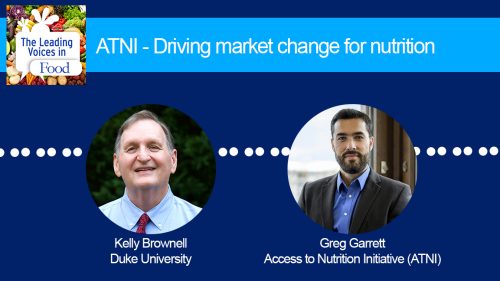 E256: ATNI – driving market change towards nutrition
Now more than ever, it’s important to challenge the world’s food and beverage manufacturers to address nutrition issues like obesity and undernutrition. Today, we’re going to discuss the 2024 Global Access to Nutrition Index, a very important ranking system that evaluates companies on their nutrition related policies, product portfolios, marketing practices, and engagement with stakeholders. The index is an accountability strategy produced by ATNI, the Access to Nutrition Initiative, a global nonprofit foundation seeking to drive market change for nutrition. Our guest today is Greg Garrett, Executive Director of ATNI.
Related podcasts: Addiction & Food | Advocacy & Food | Diet & Nutrition | Economics of the food system | Food Industry Behavior & Marketing | Food Policy | Ultra-processed Food & Additives |
 E205: Here’s what sugar and zero-calorie sweeteners do to your body
May 17, 2023
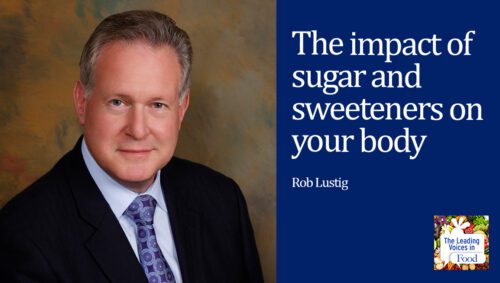 E205: Here’s what sugar and zero-calorie sweeteners do to your body
Today we speak with an expert on sugar and things meant to replace it. The stakes are high. Very high. Sugar consumption in the population is astronomical and so is the use of sugar replacements. Knowing the impacts of both could help experts provide dietary guidance and help consumers make decisions. Dr. Robert Lustig is Professor Emeritus of Pediatrics in the Division of Endocrinology at the University of California, San Francisco. He specializes on the regulation of energy balance by the central nervous system; body weight regulation, appetite, metabolism, and is very well known for his work on sugar and their substitutes and on policies aimed at improving the diet of the population. A YouTube video on the effects of consuming sugar called “Sugar: The Bitter Truth,” has now been viewed 24 million times.
Related podcasts: Addiction & Food | Diet & Nutrition | Food Industry Behavior & Marketing | Food Safety & Food Defense | Microbiome | Zero Calorie Sweeteners |
E177: Introducing Operation Good Food & Beverages – New Way to Think about Black Activism
July 27, 2022
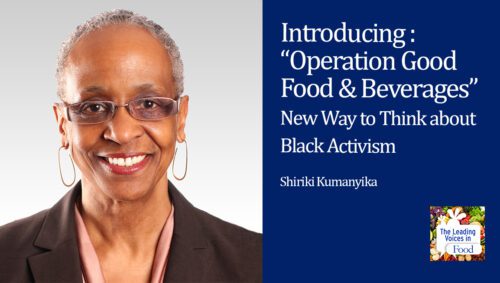 E177: Introducing Operation Good Food & Beverages – New Way to Think about Black Activism
What can be done to reverse racialized marketing of unhealthy foods to Black Americans? What if healthy eating could be seen as a radical act, or even as a form of Black activism and liberation? Today, we’re talking about these issues with Dr. Shiriki Kumanyika about a new campaign called Operation Good Food and Beverages. This is an advocacy movement developed by and for Black youth who want to reclaim healthy food as part of Black lives. Shiriki is an emeritus professor of biostatistics and epidemiology at the Perelman School of Medicine at the University of Pennsylvania, and research professor at the Drexel University Dornsife School of Public Health.
Related podcasts: Addiction & Food | Advocacy & Food | Childhood Obesity | Equity, Race & Food Justice | Food Industry Behavior & Marketing |