
Podcast Topic: Diet & Nutrition
The Leading Voices in Food
Podcast Topic: Diet & Nutrition
 E290: Grading the Biggest US Grocery Stores on Healthy Offerings
January 15, 2026
 E290: Grading the Biggest US Grocery Stores on Healthy Offerings
Do you ever wonder whether your grocery store cares about whether you have a healthy diet? Every time we shop or read advertisement flyers, food retailers influence our diets through product offerings, pricings, promotions, and of course store design. Think of the candy at the checkout counters. When I walk into my Costco, over on the right there’s this wall of all these things they would like me to buy and I’m sure it’s all done very intentionally. And so, if we’re so influenced by these things, is it in our interest? Today we’re going to discuss a report card of sorts for food retailers and the big ones – Walmart, Kroger, Ahold Delhaize USA, which is a very large holding company that has a variety of supermarket chains. And this is all about an index produced by the Access to Nutrition Initiative (ATNi), a global foundation challenging the food industry investors and policy makers to shape a healthier food system. The US Retail Assessment 2025 Report evaluates how these three businesses influence your access to nutritious and affordable foods through their policies, commitments, and actual performance. The Access to Nutrition Initiatives’ director of Policy and Communications, Katherine Pittore is here with us to discuss the report’s findings. We’ll also speak with Eva Greenthal, who oversees the Center for Science in the Public Interest’s Federal Food Labeling work.
Related podcasts: Advocacy & Food | Diet & Nutrition | Economics of the food system | Food Industry Behavior & Marketing | Food Policy |
E289: Posting calorie counts on menus should be just one strategy of many
December 16, 2025
 E289: Posting calorie counts on menus should be just one strategy of many
In April, 2022, England introduced a mandatory calorie labeling requirement for large food-away-from-home food outlets or out of home food outlets. The big idea behind the policy was that by showing the kilocalorie content of menu items, food businesses may reformulate their offerings, and consumers may choose lower calorie options. Results from a study that asked the question – Did the energy content of menu items actually change? – were recently published in the British Medical Journal. In today’s episode, researchers Jean Adams of the University of Cambridge and Mike Essman from Duke University’s World Food Policy Center will discuss the study in detail, including its strengths, limitations, and implications. And then explore how it fits into the wider policy landscape around food labeling and public health.
Related podcasts: Diet & Nutrition | Eating Disorders | Food Industry Behavior & Marketing | Food Policy | Food, Psychology & Neuroscience |
E287: Food policy insights from government agency insider Jerold Mande
November 25, 2025
 E287: Food policy insights from government agency insider Jerold Mande
We speak today to nutrition and policy expert Jerold Mande, the CEO of Nourish Science, a non-governmental organization focused on solving the country’s nutrition crisis. Jerry is also an adjunct professor of nutrition at the Harvard School of Public Health and a fellow at the Tisch College of Civic Life at Tufts University. Jerry has had a long and distinguished public policy career. Among his posts in government, he served in the Food and Drug Administration (FDA) and served as Deputy Undersecretary for Food Safety at the US Department of Agriculture in charge of Food Safety and Inspection Service (FSIS) from 2009 to 2011. He co-founded Nourish Science in 2022 with a goal of ensuring every child reaches age 18 at a healthy weight and in good metabolic health.
Related podcasts: Addiction & Food | Diet & Nutrition | Economics of the food system | Food Industry Behavior & Marketing | Food Policy | History & Food |
E285: Gut instincts, food, and decision making
October 23, 2025
 E285: Gut instincts, food, and decision making
The gut is in the news. It’s really in the news. Catapulted there from exciting developments coming from laboratories all around the world. Links of gut health with overall health are now quite clear and surprising connections are being discovered between gut health and things like dementia and Alzheimer’s. But how does the gut communicate with other parts of the body in ways that make it this important, and where does the brain figure into all this? Well, there’s some interesting science going on in this topic, and a leading person in this area is Dr. Diego Bohorquez. Dr. Bohorquez is the associate professor of medicine, of molecular genetics and microbiology and of cell biology at the Duke University School of Medicine.
Related podcasts: Diet & Nutrition | Microbiome | Ultra-processed Food & Additives | Zero Calorie Sweeteners |
E281: Is ultra-processed food still food?
August 28, 2025
 E281: Is ultra-processed food still food?
In this episode, Dr. Chris van Tulleken, a physician and professor from University College London, discusses the alarming reality of ultra-processed foods (UPFs) and their impact on our health. Van Tulleken details his own month-long experiment consuming UPFs, resulting in significant weight gain and various health issues. He explains the scientific definition of UPFs, their industry-driven design to enhance addictiveness, and the broader implications on public health. The conversation delves into the addiction potential of UPFs, their effect on brain chemistry, and the critical need for policy change to address these issues. Hosted by Kelly Brownell, this episode offers a thorough, eye-opening exploration of why we can’t stop eating food that isn’t really food.
Related podcasts: Addiction & Food | Childhood Obesity | Diet & Nutrition | Food Industry Behavior & Marketing | Food Policy | Food Safety & Food Defense | Food, Psychology & Neuroscience | Obesity | Ultra-processed Food & Additives |
E265: Exercise vital for quality of health – especially during weight loss
February 26, 2025
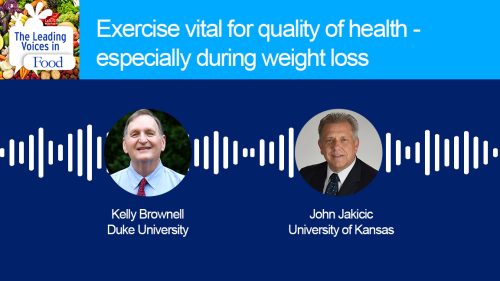 E265: Exercise vital for quality of health – especially during weight loss
Everyone knows that it’s a good idea to be physically active, but behind that basic knowledge lies a fascinating field of research on the role that physical activity plays in health and in weight control, along with answers to questions such as how much exercise I should get, is there a best time of day to do it, is one type of exercise better than others, etc. Few people can rival Dr. John Jakicic in expertise in this arena. John is a professor in the Department of Internal Medicine in the Division of Physical Activity and Weight Management at the University of Kansas Medical Center. His work has led the field for many years.
Related podcasts: Diet & Nutrition | Weight Stigma |
E261: Here’s what you don’t know about food safety
January 23, 2025
 E261: Here’s what you don’t know about food safety
For many years in talks that I gave, I showed a slide with an ingredient list from a food most people know. Just to see if the audience could guess what the food was, based on what it was made of. It was very hard for people to guess. A few people might come close, but very few people would guess. And it was pretty hard because the food contained 56 ingredients. This is in one food. And the ingredient list had chemical names, flavorings, stabilizers, and heaven knows what else. But 56 things in one, just one food in the food supply. Pretty amazing to think what kind of things we’re bombarded with in foods we eat in our everyday lives. So, one key question is do we know what all this stuff does to us, either individually or in combination? So, how does ingredient 42 interact with ingredient 17? Even if we happen to know what they do individually, which we may not. And, who’s looking out for the health of the population, and who has regulatory control over these things? Today we’re joined by the author of a new article on this topic published in the American Journal of Public Health. Jennifer Pomeranz is an attorney and is Associate Professor of Public Health Policy and Management in the School of Global Public Health at New York University. The food, by the way, was a chocolate fudge Pop Tart.
Related podcasts: Diet & Nutrition | Food Industry Behavior & Marketing | Food Policy | Food Safety & Food Defense | Ultra-processed Food & Additives |
E259: Your state of the science on weight loss drugs
January 8, 2025
 E259: Your state of the science on weight loss drugs
About two years ago, we released a podcast with Dr. Thomas Wadden of the University of Pennsylvania describing work on a new generation of medications to treat diabetes and obesity. They were really taking the field by storm. Since then, much more is known since many additional studies have been published and so many people have been using the drugs. So many, in fact, the market value of the Danish company, Novo Nordisk, one of the two major companies selling the drugs, has gone up. It is now greater than the entire budget of the country of Denmark. This single company is responsible for about half of Denmark’s economic expansion this year. So, a lot of people are now taking the drugs and this is a great time for an update on the drugs. And we’re fortunate to have two of the world’s leading experts join us: Dr. Wadden, Professor of Psychology and Psychiatry at the University of Pennsylvania School of Medicine and the inaugural Albert J. Stunkard Professor of Psychiatry at Penn. Joining us as well as Dr. Robert Kushner, a physician and professor of medicine at Northwestern University and a pioneer in testing treatments for obesity.
Related podcasts: Diet & Nutrition | Food, Psychology & Neuroscience | Obesity | Weight Stigma |
E256: ATNI – driving market change towards nutrition
November 21, 2024
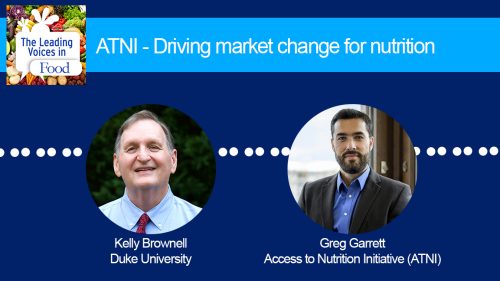 E256: ATNI – driving market change towards nutrition
Now more than ever, it’s important to challenge the world’s food and beverage manufacturers to address nutrition issues like obesity and undernutrition. Today, we’re going to discuss the 2024 Global Access to Nutrition Index, a very important ranking system that evaluates companies on their nutrition related policies, product portfolios, marketing practices, and engagement with stakeholders. The index is an accountability strategy produced by ATNI, the Access to Nutrition Initiative, a global nonprofit foundation seeking to drive market change for nutrition. Our guest today is Greg Garrett, Executive Director of ATNI.
Related podcasts: Addiction & Food | Advocacy & Food | Diet & Nutrition | Economics of the food system | Food Industry Behavior & Marketing | Food Policy | Ultra-processed Food & Additives |
E255: Reducing food waste: Less seafood wasted than thought in US
November 18, 2024
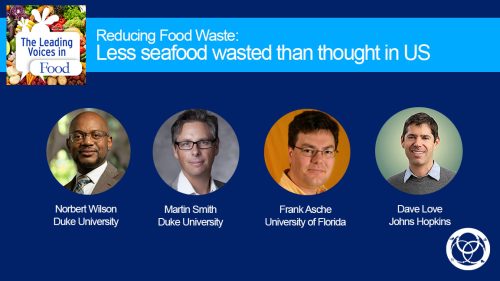 E255: Reducing food waste: Less seafood wasted than thought in US
The U. S. is the largest importer of aquatic foods, which includes fresh and saltwater fish, crustaceans, mollusks, and aquatic plants served in restaurants and homes. A critical piece of this global market is the cold chain, keeping these foods chilled or frozen during storage and transport to market. With 44 percent of aquatic foods sold live or fresh globally, the percentage of fresh over frozen aquatic foods creates an extra logistical cold chain challenge. What’s more, most aquatic foods become, well, fishy from cold chain disruptions, which can cause perceived food safety concerns, potentially resulting in food getting tossed into the bin. Until recently, research to understand just how much aquatic food gets wasted or lost has been spotty. However, in a recent Nature Food article, researchers argue that aquatic food loss and waste in the United States is actually half of earlier estimates. And that’s good news that we’ll explore today. This interview is part of an ongoing exploration of food loss and waste.
Related podcasts: Agriculture & Tech | Climate Change, Environment & Food | Diet & Nutrition | Fisheries & Food Policy | Food Safety & Food Defense |