
Podcast Topic: Food Policy
The Leading Voices in Food
Podcast Topic: Food Policy
 E290: Grading the Biggest US Grocery Stores on Healthy Offerings
January 15, 2026
 E290: Grading the Biggest US Grocery Stores on Healthy Offerings
Do you ever wonder whether your grocery store cares about whether you have a healthy diet? Every time we shop or read advertisement flyers, food retailers influence our diets through product offerings, pricings, promotions, and of course store design. Think of the candy at the checkout counters. When I walk into my Costco, over on the right there’s this wall of all these things they would like me to buy and I’m sure it’s all done very intentionally. And so, if we’re so influenced by these things, is it in our interest? Today we’re going to discuss a report card of sorts for food retailers and the big ones – Walmart, Kroger, Ahold Delhaize USA, which is a very large holding company that has a variety of supermarket chains. And this is all about an index produced by the Access to Nutrition Initiative (ATNi), a global foundation challenging the food industry investors and policy makers to shape a healthier food system. The US Retail Assessment 2025 Report evaluates how these three businesses influence your access to nutritious and affordable foods through their policies, commitments, and actual performance. The Access to Nutrition Initiatives’ director of Policy and Communications, Katherine Pittore is here with us to discuss the report’s findings. We’ll also speak with Eva Greenthal, who oversees the Center for Science in the Public Interest’s Federal Food Labeling work.
Related podcasts: Advocacy & Food | Diet & Nutrition | Economics of the food system | Food Industry Behavior & Marketing | Food Policy |
E289: Posting calorie counts on menus should be just one strategy of many
December 16, 2025
 E289: Posting calorie counts on menus should be just one strategy of many
In April, 2022, England introduced a mandatory calorie labeling requirement for large food-away-from-home food outlets or out of home food outlets. The big idea behind the policy was that by showing the kilocalorie content of menu items, food businesses may reformulate their offerings, and consumers may choose lower calorie options. Results from a study that asked the question – Did the energy content of menu items actually change? – were recently published in the British Medical Journal. In today’s episode, researchers Jean Adams of the University of Cambridge and Mike Essman from Duke University’s World Food Policy Center will discuss the study in detail, including its strengths, limitations, and implications. And then explore how it fits into the wider policy landscape around food labeling and public health.
Related podcasts: Diet & Nutrition | Eating Disorders | Food Industry Behavior & Marketing | Food Policy | Food, Psychology & Neuroscience |
E287: Food policy insights from government agency insider Jerold Mande
November 25, 2025
 E287: Food policy insights from government agency insider Jerold Mande
We speak today to nutrition and policy expert Jerold Mande, the CEO of Nourish Science, a non-governmental organization focused on solving the country’s nutrition crisis. Jerry is also an adjunct professor of nutrition at the Harvard School of Public Health and a fellow at the Tisch College of Civic Life at Tufts University. Jerry has had a long and distinguished public policy career. Among his posts in government, he served in the Food and Drug Administration (FDA) and served as Deputy Undersecretary for Food Safety at the US Department of Agriculture in charge of Food Safety and Inspection Service (FSIS) from 2009 to 2011. He co-founded Nourish Science in 2022 with a goal of ensuring every child reaches age 18 at a healthy weight and in good metabolic health.
Related podcasts: Addiction & Food | Diet & Nutrition | Economics of the food system | Food Industry Behavior & Marketing | Food Policy | History & Food |
E286: How ‘least cost diet’ models fuel food security policy
October 31, 2025
 E286: How ‘least cost diet’ models fuel food security policy
Governments use something called a ‘least cost diet’ to monitor food access, inform policy discussions, and target interventions to improve food security and nutrition. So, what is the least cost diet? Well, it’s a minimum amount of money needed to purchase a nutritionally adequate diet. Today we are lucky to have two researchers who share an interest in working with least cost diets, understanding their efficacy and thinking about that both domestically in the US and internationally. Our guests today are food and nutrition policy economists Will Masters and Parke Wilde from Tufts University’s Friedman School of Nutrition, science and Policy.
Related podcasts: Climate Change, Environment & Food | COVID-19 Pandemic Impacts on Food | Economics of the food system | Food Policy | International Food & Ag Policy |
E281: Is ultra-processed food still food?
August 28, 2025
 E281: Is ultra-processed food still food?
In this episode, Dr. Chris van Tulleken, a physician and professor from University College London, discusses the alarming reality of ultra-processed foods (UPFs) and their impact on our health. Van Tulleken details his own month-long experiment consuming UPFs, resulting in significant weight gain and various health issues. He explains the scientific definition of UPFs, their industry-driven design to enhance addictiveness, and the broader implications on public health. The conversation delves into the addiction potential of UPFs, their effect on brain chemistry, and the critical need for policy change to address these issues. Hosted by Kelly Brownell, this episode offers a thorough, eye-opening exploration of why we can’t stop eating food that isn’t really food.
Related podcasts: Addiction & Food | Childhood Obesity | Diet & Nutrition | Food Industry Behavior & Marketing | Food Policy | Food Safety & Food Defense | Food, Psychology & Neuroscience | Obesity | Ultra-processed Food & Additives |
E280: Industry user fees could fix a food safety loophole for FDA
August 25, 2025
 E280: Industry user fees could fix a food safety loophole for FDA
The Food and Drug Administration or FDA regulates roughly 78% of the US food supply. This includes packaged products, food additives, infant formula, ultra-processed foods, and lots more. However, an analysis by the Environmental Working Group found that 99% of new food ingredients enter our food supply through a legal loophole that skirts FDA oversight and seems, to me at least, to be incredibly risky. Today we’re speaking with two authors of a recent legal and policy analysis published in the Journal Health Affairs. They explain what this loophole is and its risks and suggest a new user fee program to both strengthen the FDA’s ability to regulate food ingredients and address growing concerns about food safety. Our guests are Jennifer Pomeranz Associate Professor of Public Health Policy and Management at New York University School of Global Public Health and Emily Broad, director of Harvard Law School Center for Health Law and Policy Innovation.
Related podcasts: Food Industry Behavior & Marketing | Food Policy | Food Safety & Food Defense |
E278: Here’s how screen time affects our kids’ eating, activity, and mental health
July 15, 2025
 E278: Here’s how screen time affects our kids’ eating, activity, and mental health
Parents, educators, public health experts, legal officials like State Attorneys General, and a surprisingly bipartisan collection of legislators have raised alarms and taken action to control the impact of digital media on children. There are a great many issues to be concerned about, one of which is food, nutrition, and health. Today’s guests are in a unique position to address this issue and help us think of a path forward. Dr. Amanda Staiano is associate professor in Pediatric Obesity and Health Behavior at the Pennington Biomedical Research Center, which is affiliated with Louisiana State University. Dr. Thomas Robinson is the Irving Schulman Endowed Professor in Child Health and professor of Pediatrics and of Medicine at the Stanford University Medical School. Dr. Staiano and Robinson have done groundbreaking work on children’s exposure to digital media.
Related podcasts: Addiction & Food | Child Development & Nutrition | Childhood Obesity | Food Industry Behavior & Marketing | Food Policy | Obesity | Screen time and Food | Ultra-processed Food & Additives |
E277: Food Fight – from plunder and profit to people and planet
June 27, 2025
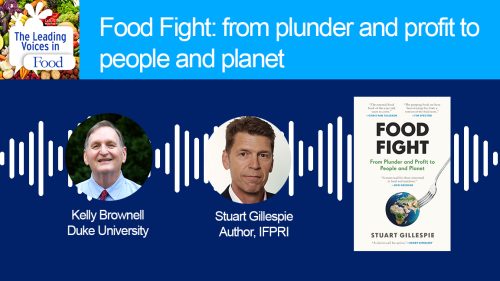 E277: Food Fight – from plunder and profit to people and planet
Today we’re talking with health and nutrition expert Dr. Stuart Gillespie, author of a new book entitled Food Fight: from Plunder and Profit to People and Planet. Using decades of research and insight gathered from around the world, Dr. Gillespie wants to reimagine our global food system and plot a way forward to a sustainable, equitable, and healthy food future – one where our food system isn’t making us sick. Certainly not the case now. Over the course of his career, Dr. Gillespie has worked with the UN Standing Committee on Nutrition in Geneva with UNICEF in India and with the International Food Policy Research Institute, known as IFPRI, where he’s led initiatives tackling the double burden of malnutrition and agriculture and health research. He holds a PhD in human nutrition from the London School of Hygiene and Tropical Medicine.
Related podcasts: Economics of the food system | Equity, Race & Food Justice | Food Industry Behavior & Marketing | Food Policy | History & Food | International Food & Ag Policy |
E270: Do food labels influence kids shopping choices?
April 16, 2025
 E270: Do food labels influence kids shopping choices?
As any parent knows, it is really important to help our children to make healthy food choices. I know as a father who cooks for my child, it is really critical that I introduce her to fruits and vegetables and encourage whole grains and try to manage the amount of additional sugars, but it’s hard. We do this with the goal of trying to make sure that our child is able to eat healthy once she leaves the home. That she’s able to make healthy choices there. But it’s not just about the future. My child is making choices even today at school and outside of school, and the question is, can we help her make those choices that are going to lead to healthy food outcomes?
Do food labels on products encourage children to make healthy food choices if it indicates good ingredients? Or would labels that warn against nutrients of concern actually discourage kids from using those or consuming those products? Today we’re going to actually explore those questions in a particular context- in Chile. In 2016, the Chilean government implemented a comprehensive set of obesity prevention policies aimed at improving the food environment for children. Last year on this podcast, we actually explored how the Chilean food laws affected school food purchases. But now today, we’re going to explore how food labels are influencing youth outside of school. It is my pleasure to welcome back my colleagues, Gabriela Fretes, who is an associate research fellow at the International Food Policy Research Institute, or IFPRI; and Sean Cash, who is an economist and chair of the Division of Agriculture, food and Environment at Tufts University at the Freedman School of Nutrition, Science and Policy.
E262: Impact of skimming and shimming fraud on SNAP recipients
January 30, 2025
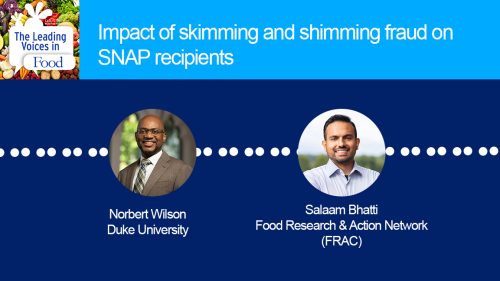 E262: Impact of skimming and shimming fraud on SNAP recipients
On our podcast, we have often talked about the Supplemental Nutrition Assistance Program, or SNAP. In many of those conversations, we’ve talked about the benefits and eligibility, and ways to improve the work that SNAP does to help low-income families meet their food needs. In today’s podcast, we’re going to turn our attention to a particular challenge, and it’s the SNAP skimming fraud. To help us understand this and the larger context of SNAP, we have the great pleasure of talking with Salaam Bhatti, who is the director of SNAP at the Food Research and Action Center, or FRAC.
Related podcasts: Advocacy & Food | Food Insecurity | Food Policy |