
Podcast Topic: Agriculture & Tech
The Leading Voices in Food
Podcast Topic: Agriculture & Tech
 E294: Liberatory Agriculture in Afterlives of the Plantation
March 26, 2026
 E294: Liberatory Agriculture in Afterlives of the Plantation
In 1881, African American educator and political leader Booker T. Washington founded Tuskegee Institute in Tuskegee, Alabama. The school’s mission was to provide practical education and vocational training in fields such as agriculture and mechanics to African Americans in the post-Reconstruction South. Tuskegee ultimately became a world-renowned agricultural and industrial school for African Americans – and actually for all people. Today, we’re speaking with Duke University’s Jarvis McInnis about his award-winning book Afterlives of the Plantation: Plotting Agrarian Futures in the Global Black South.
Related podcasts: Agriculture & Tech | Community & Economic Development | Equity, Race & Food Justice | History & Food |
E291: Pathway to Market is Complicated for Cell-Cultivated Protein
February 24, 2026
 E291: Pathway to Market is Complicated for Cell-Cultivated Protein
How can we meet the demand for meat as the global population grows? Today we are discussing cell-cultivated protein, a new meat production option that could compliment conventional livestock husbandry and seafood harvesting. Cell-cultivated protein is a real meat that is grown from animal cells. The production process involves taking cells from an animal, multiplying them in a nutrient rich medium, and forming muscle and fat tissues. Like any other food, cell-cultivated proteins are subject to US and state level regulations before they are made available to US consumers for purchase and consumption. Proponents of cell-cultivated proteins say it offers a slaughter free option for protein that may also reduce land use, produce fewer greenhouse gas emissions, and reduce the harvesting impact on marine fisheries compared to traditional approaches. Food science for cell-cultivated protein is still evolving and the sector faces challenges such as scaling the technology for large scale production and achieving an affordable product for consumers. Questions remain around what to call these manufactured meats and how to accurately – and yet enticingly – label them for consumers.
Our guests today are Kate Consavage Stanley from Duke University and Katariina Koivusaari from North Carolina State University, both post-doctoral researchers with the Bezos Center for Sustainable Proteins at North Carolina State University. Kate and Katariina, together with our research team recently published an article examining policy activity across the United States titled Exploring the US Regulatory and Legislative Landscapes for Cell-cultivated Meat and Seafood in the journal Trends in Food Science and Technology.
E288: Farmlink’s responsive, logistical success preventing food waste
December 8, 2025
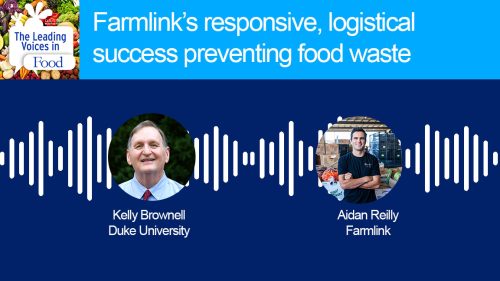 E288: Farmlink’s responsive, logistical success preventing food waste
Today we’re speaking with Aidan Reilly, co-founder and chief of External Affairs at the Farmlink Project, a national nonprofit connecting farmers with surplus produce to communities facing insecurity. What’s especially interesting about Farmlink (https://www.farmlinkproject.org/) is that it was started by college students in 2020 as a response to the food supply challenges our nation experienced during the COVID-19 pandemic. The project is now a nationwide movement of college students who provide a key logistical link in a food system that currently sees up to a third of all food produced go to waste. The program delivers fresh produce to food banks as opposed to packaged or processed foods at zero cost, as opposed to charging delivery fees.
Related podcasts: Agriculture & Tech | COVID-19 Pandemic Impacts on Food | Food Banks, Food Pantries & Soup Kitchens | Food Waste & Implications |
E282: Are healthy, environmentally sustainable diets economically achievable for everyone?
September 17, 2025
 E282: Are healthy, environmentally sustainable diets economically achievable for everyone?
In today’s episode, we’re discussing the complex and urgent topic of global food demand. The United Nations Sustainable Development Goals, or SDGs, ask countries to make measurable progress in reducing poverty, achieving zero hunger, and supporting every individual in realizing good health. While also mitigating climate change, sustaining the environment and responsible consumption and production habits. Researchers have recommended sustainable diets – planetary health diets. For example, the Eat Lancet Planetary Health Diet. However, others have criticized some of these diets for not addressing the economic and social impacts of transitioning to such diets. Is it possible to balance changing diets, rising incomes, and economic growth with economic feasibility, environmental impact, and long-term sustainability? Well, that’s what our goals are today. Our guests today are Andrew Muhammad of the University of Tennessee Institute of Agriculture, and Emiliano Lopez Barrera from Texas A&M. They are my co-authors on a new paper in the Annual Review of Resource Economics entitled Global Food Demand: overcoming Challenges to Healthy and Sustainable Diets.
Related podcasts: Agriculture & Tech | Climate Change, Environment & Food | Community & Economic Development | Economics of the food system | International Food & Ag Policy |
E279: Feed Us With Trees – the surprising importance of nuts
July 31, 2025
 E279: Feed Us With Trees – the surprising importance of nuts
Every day, with few exceptions, I eat a handful of nuts. Usually a combination of almonds, walnuts, pecans, cashews, and pistachios. And they taste good for sure. But I’m responding mainly to research showing that consumption of nuts is related to less chronic disease. In particular, eating nuts lowers levels of inflammation related to heart disease and diabetes, and may improve cholesterol levels among other benefits. So, I saw it as welcome news that someone has just published a book about nuts, all aspects of nuts, actually. Today we’re joined by NPR, food Writer Elspeth Hay author of a new book called Feed Us with Trees- nuts, and The Future of Food. And I had no idea. Nuts were so interesting until I dove in a little bit. Elspeth has gathered stories from dozens of nut growers, scientists, indigenous knowledge keepers, researchers and food professionals. She writes that humans once grew their staple crops in forest gardens of perennial nuts, such as oaks, chestnuts, and hazelnuts in these species. Particularly important to the environment as well as to human wellbeing.
Related podcasts: Agriculture & Tech | Alternative Proteins | Climate Change, Environment & Food | History & Food | Regenerative Agriculture |
E276: Climate Change – A little less beef is part of the solution
June 20, 2025
 E276: Climate Change – A little less beef is part of the solution
Interest and grave concern have been mounting over the impact of agriculture and the food choices we all make on the environment, particularly on climate change. With natural weather disasters occurring much more frequently and serious threats from warming of the atmosphere in general, it’s natural to look for places to make change. One person who has thought a lot about this is our guest today, Dr. William Dietz of George Washington University. He’s been a prominent voice in this space. Bill, you’re one of the people in the field I respect most because our relationship goes back many years. Bill is professor and director of research and policy at the Global Food Institute at George Washington University. But especially pertinent to our discussion today is that Dr. Dietz was co-chair of the Lancet Commission on the global syndemic of obesity, under nutrition and climate change. Today, we’ll focus on part of that discussion on beef in particular.
Related podcasts: Agriculture & Tech | Alternative Proteins | Climate Change, Environment & Food | Regenerative Agriculture |
E275: Against the Grain – A Plea for Regenerative Ag
June 16, 2025
 E275: Against the Grain – A Plea for Regenerative Ag
I was at a professional meeting recently and I heard an inspiring and insightful and forward-looking talk by journalist and author Roger Thurow. Roger was a reporter for the Wall Street Journal for 30 years, 20 of them as a foreign correspondent based in Europe and Africa. Roger has written a number of books including one on world hunger and another what I thought was a particularly important book entitled The First 1000 Days, A Crucial Time for Mothers and Children and the World. Now comes a new book on farmers around the world and how they are coping with the unprecedented changes they face. It was hearing about his book that inspired me to invite Mr. Thurow to this podcast and thankfully he accepted. His new book is entitled Against the Grain: How Farmers Around the Globe are transforming Agriculture to Nourish the World and Heal the Planet.
Related podcasts: Advocacy & Food | Agriculture & Tech | Climate Change, Environment & Food | Voice of Farming |
E273: Feeding innovation by taste testing alternative proteins
May 29, 2025
 E273: Feeding innovation by taste testing alternative proteins
As someone who’s been mostly vegetarian for a number of years, I have tried a lot of plant-based foods and there’s a variety of them. And so how do they really taste, not just from my perspective? Well, it’s really important to do really careful analysis, and this is going to be the subject of our conversation today. Plant-based foods are becoming increasingly healthier and cheaper. But one large question really remains for consumers. How do they taste. NECTAR, a nonprofit initiative on a mission to accelerate the alternative protein transition sets out to answer this question. Through large scale blind taste tests with thousands of consumers. NECTAR is amassing the largest publicly available sensory database on alternative protein products. In its latest report, Taste of the Industry 2025, NECTAR conducted blind sensory panels of 122 products across 14 categories and uncovered which products have achieved the taste that’s on par with their animal-based counterparts. Today we talk with NECTAR’s Director, Caroline Cotto, about which products are meeting and exceeding consumer taste expectations and what the alternative protein industry needs to do to get more products to this level. And how NECTAR’s novel dataset can be used to get there faster.
Related podcasts: Agriculture & Tech | Alternative Proteins | Climate Change, Environment & Food |
E268: Why Corporate Control of Agriculture is Cause for Concern
March 26, 2025
 E268: Why Corporate Control of Agriculture is Cause for Concern
How big is too big? When it comes to corporate concentration many observers raise concerns about the tech industry. However, in the new book, Titans of Industrial Agriculture: how a few giant corporations came to dominate the farm sector and why it matters, political economist Jennifer Clapp draws attention to the overwhelming shadow a small handful of transnational corporations cast over the global agricultural sector. Professor Clapp argues that these corporations hold concentrated power over the agricultural sector that keep industrial agricultural practices entrenched in patterns of production, despite the concerns of the social, ecological and health impacts to society. She explains how we got to this point and what it might take to make changes. Jennifer’s work at the intersection of the global economy, food security, and food systems, and the natural environment, looks specifically at issues of global governance. She is currently a member of the International Panel of Experts on Sustainable Food Systems, and a member of the Scientific Advisory Committee of the UN Food Systems Coordination Hub.
Related podcasts: Agriculture & Tech | Climate Change, Environment & Food | Community & Economic Development | Economics of the food system | Food Industry Behavior & Marketing | History & Food | International Food & Ag Policy |
E267: Nzatu uses bees and ancient grains to uplift African farmers
March 24, 2025
 E267: Nzatu uses bees and ancient grains to uplift African farmers
The climate crisis is devastating the ability of African farmers to support themselves and their communities. Farmers struggle with a lack of running water, electricity, communications, and public transportation. Entire communities are often cut off from the larger world, exacerbating and extending the poverty crisis that grips large parts of the continent. To overcome these issues, our guest, Gwen Jones, co-founded Nzatu Food Group, a regenerative agriculture business designed to protect biodiversity and mitigate climate change. Nzatu Food Group has done some remarkable pioneering work. Gwen is connected to 15,000 Sub-Saharan farmers across 15 countries through beekeeping, sustainable agricultural and conservation training, and by building an increasingly international market for farm products.
Related podcasts: Agriculture & Tech | Climate Change, Environment & Food | Community & Economic Development | Economics of the food system | History & Food | International Food & Ag Policy | Voice of Farming |