
Podcast Topic: Equity, Race & Food Justice
Podcast Topic: Equity, Race & Food Justice
 E221: Understanding Poverty, Wellbeing, and Food Security for US Children
November 30, 2023
 E221: Understanding Poverty, Wellbeing, and Food Security for US Children
As the parent of a 12-year-old child, I know that raising a child is one of the most profound and rewarding experiences of a person’s life. It is also shockingly expensive. The high cost of child rearing is particularly difficult for families with limited resources. To help us think through this issue, it is my great pleasure to welcome a colleague here at Duke: Dr. Christina Gibson-Davis, Professor of Public Policy. Christina studies economic inequality, and particularly how it affects families with children.
Related podcasts: Child Development & Nutrition | Diet & Nutrition | Equity, Race & Food Justice | Food Insecurity | Food Policy | School Meals | Social Safety Net & Food |
E213: Righting the Wrongs of Heirs Property
August 25, 2023
 E213: Righting the Wrongs of Heirs Property
In the United States, food insecurity is unevenly distributed. Recent data suggests that white households have nearly a third to one half the food insecurity rate of Black and Hispanic households. While research on the reasons for food insecurity typically focuses on income, a body of research suggests that wealth could be an important factor in food security. According to today’s guest, Conner Bailey, professor emeritus of Rural Sociology at Auburn University: “Land is one of the major sources of wealth controlled by Black families in the South, and much of this land continues to be owned as heirs property.” Thus, if we want to understand differential food and security, we need to consider that the wealth implications of heirs property.
Related podcasts: Equity, Race & Food Justice | Food Insecurity | History & Food |
E212: Do SNAP work requirements encourage self sufficiency or hurt those who need help the most?
August 17, 2023
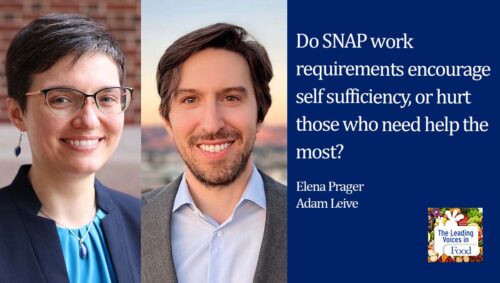 E212: Do SNAP work requirements encourage self sufficiency or hurt those who need help the most?
The Supplemental Nutrition Assistance Program is one of the largest poverty alleviation programs in the United States and provides help to around 14% of the US population. Since 1996, the program has required able-bodied adults without dependents to work in order to receive food assistance. Proponents of work requirements say it prevents government dependency. Critics, however, argue work requirements push out the people who need food assistance the most. Today we’ll talk with two economists about the impact of SNAP work requirements: University of Rochester’s Elena Prager. and Adam Leive at the University of California, Berkeley.
Related podcasts: Equity, Race & Food Justice | Food Policy | Social Safety Net & Food |
E198: Why SNAP pandemic benefits for college students should continue
March 7, 2023
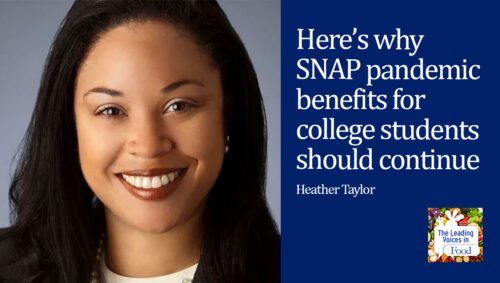 E198: Why SNAP pandemic benefits for college students should continue
There has been increasing attention to the issue of food insecurity among college students. Estimates vary, but to provide some perspective, one report found that a staggering 30% of all college students experienced food insecurity at some point in their college careers. In response to the COVID-19 pandemic, the US temporarily extended the Supplemental Nutrition Assistance Program benefits to college-aged students. But now this pandemic help is set to expire, impacting more than three million college students who have relied on this program for food. Today we speak with Heather Taylor, a former US delegate to the United Nations, and now managing director of Bread for the World. Having experienced severe food insecurity as an undergraduate student at Georgetown University, she now advocates for SNAP expansion for college students and other marginalized groups facing food insecurity.
Related podcasts: Diet & Nutrition | Equity, Race & Food Justice | Food Insecurity | Food Policy | Social Safety Net & Food |
E197: USDA plans for online WIC Benefits
February 28, 2023
 E197: USDA plans for online WIC Benefits
In February, 2023, the US Department of Agriculture announced plans to streamline and modernize WIC – the Women Infants and Children Program focused on supplemental nutrition. We’ll talk about the future of WIC today with Stacy Dean, the Deputy Undersecretary for USDA’s Food, Nutrition and Consumer Services.
Related podcasts: Child Development & Nutrition | COVID-19 Pandemic Impacts on Food | Equity, Race & Food Justice | Food Insecurity | Food Policy | Social Safety Net & Food |
E192: How to achieve food equity with SNAP
January 4, 2023
 E192: How to achieve food equity with SNAP
Today we’re speaking with coauthors of a new report by the Center for Law and Social Policy, entitled “A Community-Driven Anti-Racism Vision for SNAP.” Senior policy analyst, Parker Gilkesson, and community organizer, Tamika Moore, argue that although public benefits such as the Supplemental Nutrition Assistance Program provide critical care and support for families with low incomes, they also reinforce racism and structures of oppression.
Related podcasts: Advocacy & Food | Diet & Nutrition | Equity, Race & Food Justice | Food Insecurity | Food Policy | Social Safety Net & Food |
E190: Insights from 2nd Global Survey of School Meals
December 13, 2022
 E190: Insights from 2nd Global Survey of School Meals
School meal programs provide children with needed meals, snacks, and even take home foods throughout the world. These programs have a tremendous impact on children’s overall nutrition, physical, and emotional development, and their academic performance, as you can imagine. Much can be learned from a project that is entitled The Global Survey of School Meal Programs. Today we will be speaking about the second such survey with Global Child Nutrition Foundation Research Coordinator, Ayala Wineman, from Michigan State University.
Related podcasts: Child Development & Nutrition | Equity, Race & Food Justice | Food Insecurity | School Meals |
E187: FDA role in national strategy to end hunger
November 14, 2022
 E187: FDA role in national strategy to end hunger
In September of 2022, the White House held the first conference focused on hunger, nutrition, and health, in 50 years. The convening served as the Biden-Harris administration’s call-to-action to end hunger, and increase healthy eating, and the physical activity among Americans, by the year 2030. But how successful was this event in actually catalyzing a national strategy? We’ll hear perspectives on this from Dr. Susan Mayne, Director of the Center for Food Safety and Applied Nutrition at the Food and Drug Administration.
Related podcasts: Diet & Nutrition | Equity, Race & Food Justice | Food Insecurity | Food Policy | Social Safety Net & Food |
E186: Deep dive into challenges people face accessing food pantries
November 7, 2022
 E186: Deep dive into challenges people face accessing food pantries
The COVID-19 pandemic deeply impacted the US food chain and has heightened attention on nonprofit food pantries and soup kitchens. Today’s guest argues that sometimes the people most in need of food face the most challenges in getting it because of food pantry operating procedures. Our guest, Alana Stein has conducted research on these issues at the University of California at Davis.
Related podcasts: COVID-19 Pandemic Impacts on Food | Diet & Nutrition | Equity, Race & Food Justice | Food Banks, Food Pantries & Soup Kitchens | Food Insecurity |
E182: Memoir and Marion Nestle – Slow Cooked
October 3, 2022
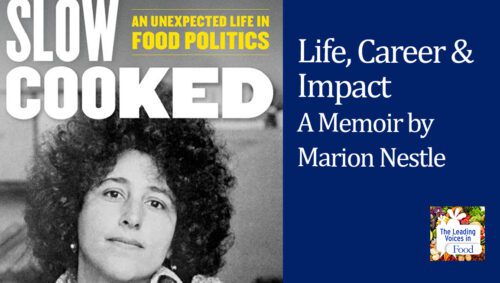 E182: Memoir and Marion Nestle – Slow Cooked
Pioneer, path breaker, field builder. These are all descriptions that apply to our guest today, Dr. Marion Nestle. Marion Nestle is the Paulette Goddard Professor of Nutrition, Food Studies, and Public Health emerita at New York University. She has been a major force in food policy for decades, partly because she is a brilliant communicator and a prolific author. Her groundbreaking book, “Food Politics,” has been published in several editions. Another book, “Unsavory Truth: How The Food Companies Skew The Science of What We Eat,” is a classic. And this just begins the list. But today we’re talking about Marion’s newest book, which is a memoir called, “Slow Cooked: An Unexpected Life in Food Politics”. It offers an unprecedented look into the life, the thinking, and the passions of one of the top figures in the field.
Related podcasts: Diet & Nutrition | Equity, Race & Food Justice | Food Policy | History & Food |