
Podcast Topic: International Food & Ag Policy
The Leading Voices in Food
Podcast Topic: International Food & Ag Policy
 E286: How ‘least cost diet’ models fuel food security policy
October 31, 2025
 E286: How ‘least cost diet’ models fuel food security policy
Governments use something called a ‘least cost diet’ to monitor food access, inform policy discussions, and target interventions to improve food security and nutrition. So, what is the least cost diet? Well, it’s a minimum amount of money needed to purchase a nutritionally adequate diet. Today we are lucky to have two researchers who share an interest in working with least cost diets, understanding their efficacy and thinking about that both domestically in the US and internationally. Our guests today are food and nutrition policy economists Will Masters and Parke Wilde from Tufts University’s Friedman School of Nutrition, science and Policy.
Related podcasts: Climate Change, Environment & Food | COVID-19 Pandemic Impacts on Food | Economics of the food system | Food Policy | International Food & Ag Policy |
E282: Are healthy, environmentally sustainable diets economically achievable for everyone?
September 17, 2025
 E282: Are healthy, environmentally sustainable diets economically achievable for everyone?
In today’s episode, we’re discussing the complex and urgent topic of global food demand. The United Nations Sustainable Development Goals, or SDGs, ask countries to make measurable progress in reducing poverty, achieving zero hunger, and supporting every individual in realizing good health. While also mitigating climate change, sustaining the environment and responsible consumption and production habits. Researchers have recommended sustainable diets – planetary health diets. For example, the Eat Lancet Planetary Health Diet. However, others have criticized some of these diets for not addressing the economic and social impacts of transitioning to such diets. Is it possible to balance changing diets, rising incomes, and economic growth with economic feasibility, environmental impact, and long-term sustainability? Well, that’s what our goals are today. Our guests today are Andrew Muhammad of the University of Tennessee Institute of Agriculture, and Emiliano Lopez Barrera from Texas A&M. They are my co-authors on a new paper in the Annual Review of Resource Economics entitled Global Food Demand: overcoming Challenges to Healthy and Sustainable Diets.
Related podcasts: Agriculture & Tech | Climate Change, Environment & Food | Community & Economic Development | Economics of the food system | International Food & Ag Policy |
E277: Food Fight – from plunder and profit to people and planet
June 27, 2025
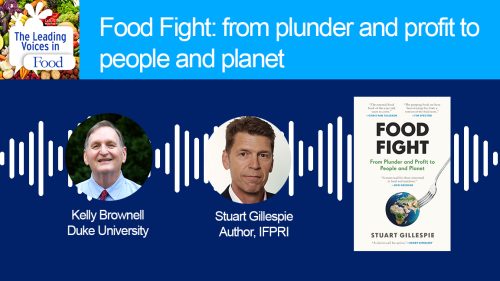 E277: Food Fight – from plunder and profit to people and planet
Today we’re talking with health and nutrition expert Dr. Stuart Gillespie, author of a new book entitled Food Fight: from Plunder and Profit to People and Planet. Using decades of research and insight gathered from around the world, Dr. Gillespie wants to reimagine our global food system and plot a way forward to a sustainable, equitable, and healthy food future – one where our food system isn’t making us sick. Certainly not the case now. Over the course of his career, Dr. Gillespie has worked with the UN Standing Committee on Nutrition in Geneva with UNICEF in India and with the International Food Policy Research Institute, known as IFPRI, where he’s led initiatives tackling the double burden of malnutrition and agriculture and health research. He holds a PhD in human nutrition from the London School of Hygiene and Tropical Medicine.
Related podcasts: Economics of the food system | Equity, Race & Food Justice | Food Industry Behavior & Marketing | Food Policy | History & Food | International Food & Ag Policy |
E268: Why Corporate Control of Agriculture is Cause for Concern
March 26, 2025
 E268: Why Corporate Control of Agriculture is Cause for Concern
How big is too big? When it comes to corporate concentration many observers raise concerns about the tech industry. However, in the new book, Titans of Industrial Agriculture: how a few giant corporations came to dominate the farm sector and why it matters, political economist Jennifer Clapp draws attention to the overwhelming shadow a small handful of transnational corporations cast over the global agricultural sector. Professor Clapp argues that these corporations hold concentrated power over the agricultural sector that keep industrial agricultural practices entrenched in patterns of production, despite the concerns of the social, ecological and health impacts to society. She explains how we got to this point and what it might take to make changes. Jennifer’s work at the intersection of the global economy, food security, and food systems, and the natural environment, looks specifically at issues of global governance. She is currently a member of the International Panel of Experts on Sustainable Food Systems, and a member of the Scientific Advisory Committee of the UN Food Systems Coordination Hub.
Related podcasts: Agriculture & Tech | Climate Change, Environment & Food | Community & Economic Development | Economics of the food system | Food Industry Behavior & Marketing | History & Food | International Food & Ag Policy |
E267: Nzatu uses bees and ancient grains to uplift African farmers
March 24, 2025
 E267: Nzatu uses bees and ancient grains to uplift African farmers
The climate crisis is devastating the ability of African farmers to support themselves and their communities. Farmers struggle with a lack of running water, electricity, communications, and public transportation. Entire communities are often cut off from the larger world, exacerbating and extending the poverty crisis that grips large parts of the continent. To overcome these issues, our guest, Gwen Jones, co-founded Nzatu Food Group, a regenerative agriculture business designed to protect biodiversity and mitigate climate change. Nzatu Food Group has done some remarkable pioneering work. Gwen is connected to 15,000 Sub-Saharan farmers across 15 countries through beekeeping, sustainable agricultural and conservation training, and by building an increasingly international market for farm products.
Related podcasts: Agriculture & Tech | Climate Change, Environment & Food | Community & Economic Development | Economics of the food system | History & Food | International Food & Ag Policy | Voice of Farming |
 E252: Is farm-level environmental impact reporting needed or even possible?
October 22, 2024
 E252: Is farm-level environmental impact reporting needed or even possible?
In today’s podcast, we’re discussing Fast and Furious. But it’s not the movie series starring Vin Diesel. Instead, the catchphrase describes rapidly increasing and somewhat confusing food system environmental impact reporting. Food firms, farmers, and governments all have a clear need for more quantitative environmental impact data in order to measure and understand factors such as carbon footprint, sustainable agricultural practices, and food supply chain processes. But there is no single standard for such reporting and different measurement methodologies make it difficult to assess progress. What’s more, greater transparency regarding environmental impacts and food systems will affect trade and supply chains. Our guest today is Koen Deconinck from the Trade and Agricultural Directorate of the Organization for Economic Cooperation and Development, or OECD for short.
Related podcasts: Climate Change, Environment & Food | Economics of the food system | Food Industry Behavior & Marketing | Food Safety & Food Defense | International Food & Ag Policy |
 E248: Climate-smart strategies for small-scale fishing communities
September 26, 2024
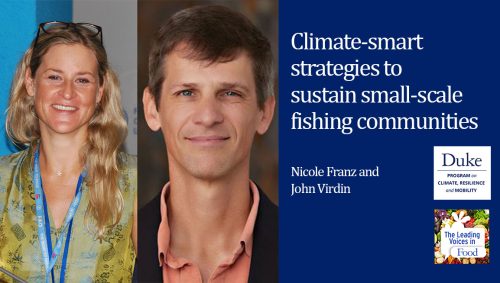 E248: Climate-smart strategies for small-scale fishing communities
Join host Norbert Wilson and co-host Kerilyn Schewel in the latest episode of the Leading Voices in Food podcast as they dive deep into the world of small-scale fisheries with two distinguished guests: Nicole Franz from the Food and Agriculture Organization of the United Nations (FAO) and John Virdin from Duke University’s Nicholas Institute for Energy, Environment, and Sustainability. Discover the significant role small-scale fisheries play in food security, economic development, and community livelihoods. Learn about the unique challenges these fisheries face, and how community-led climate adaptation alongside top-down national policies can help build resilience. This episode also highlights collaborative efforts between academia and organizations like FAO, painting a comprehensive picture of the state and future of small-scale fisheries.
Related podcasts: Agriculture & Tech | Climate Change, Environment & Food | Community & Economic Development | Fisheries & Food Policy | Food Insecurity | Food Policy | International Food & Ag Policy |
E247: Cultivating food security and community stability in the Dry Corridor
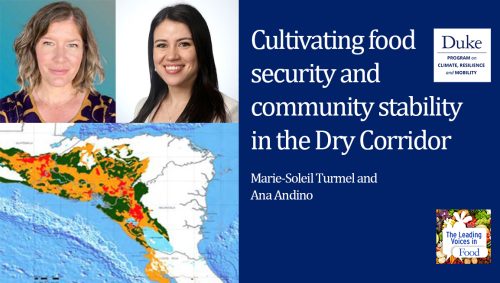 E247: Cultivating food security and community stability in the Dry Corridor
With food insecurity rising the world over, we cannot escape the reality that climate change is changing our food supply. This means people’s livelihoods and lifestyles are changing too, particularly in developing countries. Join us on the Leading Voices in Food podcast as we discuss the rising impact of climate change on food security and livelihoods in Central America, specifically Honduras. Host Norbert Wilson, Director of the World Food Policy Center, along with co-host Sarah Bermeo, delve into the challenges and solutions with experts Marie-Soleil Turmel from Catholic Relief Services and Ana Andino from Duke University. Learn about the Dry Corridor, the effects of climate shocks, land restoration practices, and the role of international support in building community resilience.
Related podcasts: Agriculture & Tech | Climate Change, Environment & Food | Community & Economic Development | Economics of the food system | International Food & Ag Policy |
E242: Revamping debt for nature swaps could support resilient food systems
August 21, 2024
 E242: Revamping debt for nature swaps could support resilient food systems
In today’s discussion, we will explore the application of debt relief to large investments in environmental sustainability, which can also support local development, including more resilient food systems. This is particularly timely, given the juxtaposition of enormous debt burdens with increasing environmental commitments by developing countries. Debt for relief swaps, such as financial forgiveness for cash strapped countries if they invest those funds to support global environmental goods, have been around since the 1980s. However, they haven’t achieved their full economic or environmental potential, says Duke University Economic and Environmental Policy Professor Alex Pfaff. Smart reforms to improve debt relief programs can allow nations to help themselves and fulfill commitments to preserve the planet. Pfaff and colleagues described needed reforms in a recent analysis in a policy forum for the journal Science, also summarized in Foreign Policy magazine. His co-authors are sustainability expert Elizabeth Losos and conservation professor Stuart Pimm from Duke University. They note that global society has now learned lessons, not only from past debt for nature swaps, but also decades of evaluation of climate change of environmental and development policies.
Related podcasts: Climate Change, Environment & Food | Community & Economic Development | International Food & Ag Policy |
E191: Is today’s food waste a consequence of historical public policy?
December 14, 2022
 E191: Is today’s food waste a consequence of historical public policy?
Today’s podcast is part of a series on food waste. When farmers produce more of a product than people are willing to buy, or when the demand for a product falls unexpectedly, food is wasted. What role do agricultural policies and politics play in creating and perpetuating cycles of supply challenges? Our guest today is Dr. Garrett Graddy-Lovelace of American University. Garrett is an agricultural policy expert and she studies the problem of food gluts through the lens of social sciences, international affairs, history and analysis of USDA data.
Related podcasts: Agriculture & Tech | Food Industry Behavior & Marketing | Food Policy | Food Waste & Implications | International Food & Ag Policy |