
Podcast Topic: Ultra-processed Food & Additives
The Leading Voices in Food
Podcast Topic: Ultra-processed Food & Additives
 E270: Do food labels influence kids shopping choices?
April 16, 2025
 E270: Do food labels influence kids shopping choices?
As any parent knows, it is really important to help our children to make healthy food choices. I know as a father who cooks for my child, it is really critical that I introduce her to fruits and vegetables and encourage whole grains and try to manage the amount of additional sugars, but it’s hard. We do this with the goal of trying to make sure that our child is able to eat healthy once she leaves the home. That she’s able to make healthy choices there. But it’s not just about the future. My child is making choices even today at school and outside of school, and the question is, can we help her make those choices that are going to lead to healthy food outcomes?
Do food labels on products encourage children to make healthy food choices if it indicates good ingredients? Or would labels that warn against nutrients of concern actually discourage kids from using those or consuming those products? Today we’re going to actually explore those questions in a particular context- in Chile. In 2016, the Chilean government implemented a comprehensive set of obesity prevention policies aimed at improving the food environment for children. Last year on this podcast, we actually explored how the Chilean food laws affected school food purchases. But now today, we’re going to explore how food labels are influencing youth outside of school. It is my pleasure to welcome back my colleagues, Gabriela Fretes, who is an associate research fellow at the International Food Policy Research Institute, or IFPRI; and Sean Cash, who is an economist and chair of the Division of Agriculture, food and Environment at Tufts University at the Freedman School of Nutrition, Science and Policy.
E266: What’s next for school meal quality?
March 13, 2025
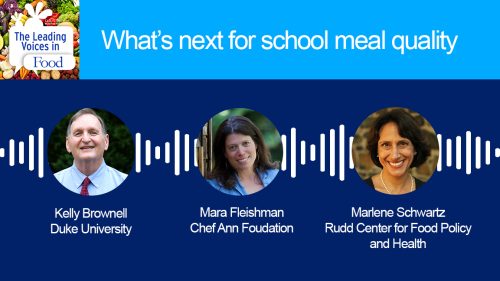 E266: What’s next for school meal quality?
The food and nutrition landscape in our schools is really important. School meals affect the health, wellbeing, energy, vitality, and ability to learn for millions and millions of children. And for those whose family struggled to buy food, the importance of school meals cannot be overstated. This makes decisions about what foods are served in schools and where they come from. Highly consequential and raises issues about national and state nutrition policies, the influence of big food companies in shaping this picture and lots more. It’s a good time to unravel all this, which we can do today. Thanks to two experts with us. Dr. Marlene Schwartz is Professor of Human Development and Family Sciences and Director of the Rudd Center for Food Policy health at the University of Connecticut. Mara Fleishman is CEO of the Chef Ann Foundation, where she has been a leader advancing school food change, advocating for scratch cook meals that promote children’s health and for more sustainable food systems.
Related podcasts: Advocacy & Food | Child Development & Nutrition | Childhood Obesity | Community & Economic Development | School Meals | Ultra-processed Food & Additives |
E261: Here’s what you don’t know about food safety
January 23, 2025
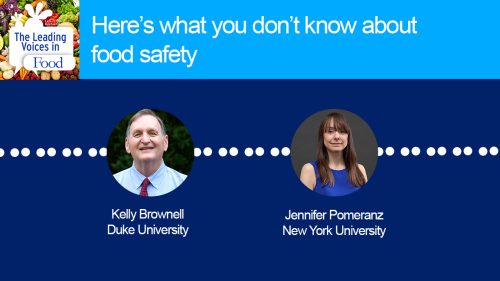 E261: Here’s what you don’t know about food safety
For many years in talks that I gave, I showed a slide with an ingredient list from a food most people know. Just to see if the audience could guess what the food was, based on what it was made of. It was very hard for people to guess. A few people might come close, but very few people would guess. And it was pretty hard because the food contained 56 ingredients. This is in one food. And the ingredient list had chemical names, flavorings, stabilizers, and heaven knows what else. But 56 things in one, just one food in the food supply. Pretty amazing to think what kind of things we’re bombarded with in foods we eat in our everyday lives. So, one key question is do we know what all this stuff does to us, either individually or in combination? So, how does ingredient 42 interact with ingredient 17? Even if we happen to know what they do individually, which we may not. And, who’s looking out for the health of the population, and who has regulatory control over these things? Today we’re joined by the author of a new article on this topic published in the American Journal of Public Health. Jennifer Pomeranz is an attorney and is Associate Professor of Public Health Policy and Management in the School of Global Public Health at New York University. The food, by the way, was a chocolate fudge Pop Tart.
Related podcasts: Diet & Nutrition | Food Industry Behavior & Marketing | Food Policy | Food Safety & Food Defense | Ultra-processed Food & Additives |
E256: ATNI – driving market change towards nutrition
November 21, 2024
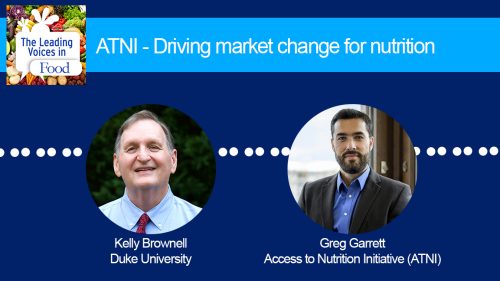 E256: ATNI – driving market change towards nutrition
Now more than ever, it’s important to challenge the world’s food and beverage manufacturers to address nutrition issues like obesity and undernutrition. Today, we’re going to discuss the 2024 Global Access to Nutrition Index, a very important ranking system that evaluates companies on their nutrition related policies, product portfolios, marketing practices, and engagement with stakeholders. The index is an accountability strategy produced by ATNI, the Access to Nutrition Initiative, a global nonprofit foundation seeking to drive market change for nutrition. Our guest today is Greg Garrett, Executive Director of ATNI.
Related podcasts: Addiction & Food | Advocacy & Food | Diet & Nutrition | Economics of the food system | Food Industry Behavior & Marketing | Food Policy | Ultra-processed Food & Additives |
 E208: Improve Your Microbiome – Improve Your Health
July 6, 2023
 E208: Improve Your Microbiome – Improve Your Health
If you want to improve your digestion, your immune system, and your overall health, one might begin with a focus on a healthy gut microbiome. Today we’re talking with Stanford University professor of microbiology and immunology Dr. Justin Sonnenburg, co-author of the book entitled, “The Good Gut: Taking Control of Your Weight, your Mood, and Your Long-Term Health.” He and his wife, research scientists Dr. Erica Sonnenburg, argue that our typical modern diet has caused the microbial diversity or intestine to shrink substantially. Turns out that’s a big problem.
Related podcasts: Diet & Nutrition | Microbiome | Ultra-processed Food & Additives |
E204: The troubling unknowns of non-caloric sweeteners
May 4, 2023
 E204: The troubling unknowns of non-caloric sweeteners
As a society, we are eating and drinking low-calorie sweeteners more and more. Researchers are working to understand the long-term impact of such sweeteners for adults and, of course, for children. This interview is part of a series on the impact of sweeteners. Our guest today is Dr. Allison Sylvetsky, Associate Professor in the Department of Exercise and Nutrition Sciences at the George Washington University – Milken Institute School of Public Health.
Related podcasts: Child Development & Nutrition | Diet & Nutrition | Food Safety & Food Defense | Microbiome | Ultra-processed Food & Additives | Zero Calorie Sweeteners |
E170: Why the US Must Reduce Sodium Intake: It’s Costing Lives
June 10, 2022
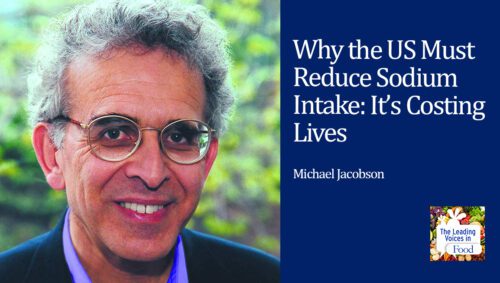 E170: Why the US Must Reduce Sodium Intake: It’s Costing Lives
Today, we’re going to talk salt with Dr. Michael Jacobson, former president and co-founder of the Center for Science in the Public Interest. Dr. Jacobson is one of the authors of an important article published recently in the journal Hypertension. The article comes to a startling conclusion that delays in implementing voluntary sodium reduction targets by the food and restaurant industry may result in nearly 265,000 preventable deaths between 2017 and 2031.
Related podcasts: Advocacy & Food | Diet & Nutrition | Food Industry Behavior & Marketing | Food Policy | Food Safety & Food Defense | Ultra-processed Food & Additives |
E159: Ultra-processed Foods Have Addiction Impact on our Bodies
March 17, 2022
 E159: Ultra-processed Foods Have Addiction Impact on our Bodies
Much has been written and said about ultra-processed foods, first in scientific circles and now more broadly in the media. This concept is relatively new, but what is even newer in this discussion is how such foods figure into the issue of food and addiction. Our guest, Dr. Ashley Gearhardt is doing pioneering work on this. So, we eat a lot of these foods. A paper published several months ago, found that as much as 80% of all calories consumed in the US and in Canada come from such foods. Such diets are high in added sugar, in fat and saturated fat and low in fiber and key vitamins and minerals. We’ve recorded earlier podcasts on ultra-processed foods, most notably with Dr. Carlos Monteiro, who created the term. But now let’s talk addiction. Ashley Gearhardt is Associate Professor in the department of psychology at the University of Michigan and as a leading expert on the issue of food and addiction.
Related podcasts: Addiction & Food | Food Safety & Food Defense | Ultra-processed Food & Additives |
E162: Ultra-processed Foods Need a Warning Label to Protect Consumers
March 3, 2022
 E162: Ultra-processed Foods Need a Warning Label to Protect Consumers
In today’s podcast, we’re talking about ultra-processed foods. Our guest today is Trish Cotter from the global public health organization Vital Strategies. She’s the author of a new commentary published in the BMJ Global Health calling for warning labels on ultra-processed foods.
Related podcasts: Addiction & Food | Food Industry Behavior & Marketing | Food Policy | Food Safety & Food Defense | Ultra-processed Food & Additives |
E150: What Food Policy Advocates Can Learn from Tobacco Industry Strategies
December 2, 2021
 E150: What Food Policy Advocates Can Learn from Tobacco Industry Strategies
This is “The Leading Voices in Food” podcast but today we’re speaking with a leading voice in tobacco control. “How come,” you might ask, “why?” So I believe for many years that the parallels between the tobacco industry and food industry practices are nothing short of stunning, and that our field would do very well to learn lessons learned from the pioneers in the tobacco wars. Our guest today is Dr. Kenneth Warner, Distinguished Emeritus Professor and former Dean of the School of Public Health at the University of Michigan. Ken’s research focuses on the economic and policy aspects of tobacco and health.
Related podcasts: Addiction & Food | Advocacy & Food | Food Policy | Soda Taxes | Ultra-processed Food & Additives |